- What Is Couples Travel Psychology?
- The Research: Does Traveling Together Strengthen a Relationship?
- Couples Travel Psychology in Practice: Benefits of Traveling as a Couple
- Psychology of Traveling With Your Partner: What Changes When You’re Away From Routine
- Couples Trip Tips: Planning Without the Friction
- Honeymoon Planning Tips: Applying This to Your First Big Trip Together
- When Travel Puts Strain on a Relationship Instead
- Conclusion: Couples Travel Psychology in Three Takeaways
- Frequently Asked Questions
Quick Answer: Couples travel psychology looks at how taking trips together shapes closeness and satisfaction. Research suggests relationships benefit most from shared novel experiences, paired with open communication. A trip helps when both partners take part in something new together and talk honestly about it, not when they simply share a hotel room.
Picture two people on the same train, one asleep, one scrolling, both physically together and mentally elsewhere. Now picture the same couple lost in an unfamiliar market, laughing as they try to order something neither can pronounce. The location is similar. The experience is not.
As a travel psychologist at Mandeha, I see this difference often. Couples travel psychology is the study of why. It looks at what happens to communication, attention and closeness when partners leave routine behind together. This article covers what the research says, how to plan a trip that supports connection, and where trips go wrong. It focuses on romantic partners. If you are comparing this with traveling with friends, that dynamic works differently. For the broader context, see the wider science of travel psychology.
What Is Couples Travel Psychology?
Couples travel psychology is the study of how traveling together affects a romantic relationship, including communication, shared attention and satisfaction. It applies established relationship psychology to real trips, asking which travel experiences bring partners closer, which create friction, and why it happens.
I use the term as a practical lens, not a treatment. A trip compresses many relationship moments into a short time: decisions, delays, shared meals, and disagreements about money and pace. That makes it a useful place to notice how you and your partner work together.
Couples travel psychology draws on relationship psychology, including self-expansion theory, which I explain in the next section. At Mandeha, we treat it as one part of applied travel psychology, focused on what you can do before, during and after a trip.
The Research: Does Traveling Together Strengthen a Relationship?
Shared novel and exciting activities are linked to higher relationship quality, so the answer is often yes, with conditions. The best-known evidence is a study published in 2000, and couples travel psychology builds on it.
In 2000, Aron, Norman, Aron, McKenna and Heyman reported in the Journal of Personality and Social Psychology that couples who shared novel and arousing activities reported higher relationship quality and satisfaction than couples who shared familiar, pleasant ones.
This fits self-expansion theory, which holds that relationships benefit when partners grow and have new experiences together. Travel is a natural way to build that kind of shared novelty. An unfamiliar city gives both of you the same unknowns to work through.
Here is how travel strengthens relationships through that lens. First, novelty gives partners a shared task, such as finding a train platform or choosing a dish. Second, working through small uncertainties together builds a sense of being on the same team. Third, the stories from these moments become part of the relationship’s shared history. Couples travel psychology treats these as mechanisms to plan for, not lucky accidents. Understanding how travel strengthens relationships also helps explain why a familiar, purely restful trip may feel relaxing without adding much new connection.
There is an important limit. This is one study, with experimental and correlational elements, and it does not show that any single trip fixes a relationship. What it supports is narrower: travel helps when it involves real shared novelty and open communication, not just being in the same place. That is how travel strengthens relationships in practice, through what you do together rather than where you are.es. Some opt for detailed spreadsheets to keep track of who’s paid for what, while others rely on the payment app to share costs.
Couples Travel Psychology in Practice: Benefits of Traveling as a Couple
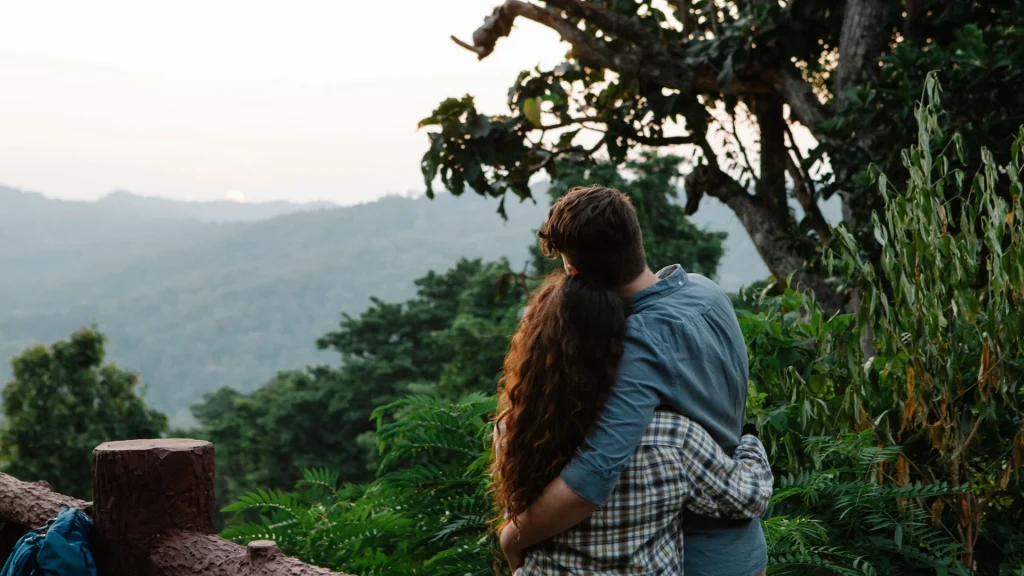
The main benefits of traveling as a couple are shared novelty, unhurried quality time and better couple communication. None is automatic, but each becomes more likely when you travel with intent.
- Shared novelty. Trying something new together, from a local cooking class to an unfamiliar bus route, creates the kind of experience the 2000 Aron et al. study examined.
- Quality time. Away from work, chores and screens, attention is easier to give. Quality time works best when both people are present, not just nearby.
- A shared story. Trips give you memories you both hold, which become reference points in later conversations.
- New views of each other. Watching a partner handle a missed connection or talk to a stranger can show strengths you rarely see at home.
- Practice at teamwork. Small decisions on the road, such as where to eat or when to rest, are low-stakes rehearsals for joint decisions at home.
These benefits of traveling as a couple are tendencies, not guarantees, and they depend on how the trip is planned.
For many couples, the clearest of the benefits of traveling as a couple is a change in attention. In daily life, phones and schedules split focus. On a trip, the same two people can spend a day with one shared goal. Couples travel psychology suggests that this shared focus, more than luxury or distance, is what tends to matter.
Psychology of Traveling With Your Partner: What Changes When You’re Away From Routine
When you travel, routine disappears, and with it the autopilot that runs most home life. That makes both helpful and difficult patterns easier to see.
At home, roles are settled: who cooks, who plans, who handles money. On a trip, those roles are up for grabs. Some couples enjoy the reset. Others fall into the same roles under more stress. The psychology of traveling with your partner is largely about noticing which of these is happening.
Unfamiliar settings also draw on your attention. Navigation, language and logistics use mental energy, so patience can run thinner than usual. Knowing this helps you read a short temper as fatigue, not as a verdict on the relationship. Couples travel psychology treats this stage as information, not a problem.
A partner is also different from other companions. Compared with traveling with people you don’t know well, a partner brings shared history, which helps you and also raises the stakes of a disagreement.
Couples Trip Tips: Planning Without the Friction

The best couples trip tips reduce surprises before you leave: agree on money, travel style and alone time in advance. A short planning conversation prevents many on-the-road arguments. Couples travel psychology gives planning one clear goal: protect shared novelty and open communication.
Use this pre-trip conversation checklist:
- Budget transparency. Share what each person is comfortable spending and which costs matter most.
- A shared wish list. Each person names three must-do items. Build the plan around the overlap and alternate the rest.
- Travel styles. Talk about pace, planning versus spontaneity, and early versus late starts.
- Alone time. Agree that an hour apart is normal, not a rejection.
- Planning load. Split research and booking so one person is not the permanent organizer.
- A pause phrase. Choose a neutral phrase that means “I need a break.”
If you want structure, a simple planning tool can help you put these preferences on paper so both of you can see them.
Good couple communication runs through all of these couples trip tips. The Gottman Institute’s travel tips also stress planning ahead, because traveling together can easily give way to quarreling and everyone wants some freedom on vacation.
Treat these couples trip tips as a starting conversation, not a contract. Check in halfway through the trip, because energy and preferences shift. A quick daily question such as “What was the best part today, and what would you change tomorrow?” keeps couple communication open.
Honeymoon Planning Tips: Applying This to Your First Big Trip Together
Good honeymoon planning tips follow the same principle: build in some novelty, protect some rest, and agree on expectations early. A honeymoon carries pressure to be perfect, which is worth naming out loud.
Many couples arrive exhausted from wedding planning. Leaving the first days unscheduled is one of the most useful honeymoon planning tips I can offer. Then pair one or two new shared experiences, such as a guided hike or a local workshop, with slow days.
Talk about what each of you hopes to feel, not only what you hope to see. Keep expectations realistic: a honeymoon is not a test of the marriage. If something goes wrong, treat it as a story you will tell later. These honeymoon planning tips also work for anniversaries and any first big trip together.
Honeymoon planning tips should also cover practical fairness. Decide together who handles bookings, and avoid surprises about cost. Couples travel psychology suggests that early honesty about money and expectations protects the mood of the trip. Good honeymoon planning tips leave room for both excitement and tiredness.
When Travel Puts Strain on a Relationship Instead
Travel strains a relationship when the planning load is uneven, expectations do not match, or there is no downtime. These problems are common and usually fixable.
- Uneven planning load. If one partner researches, books and navigates, resentment can build quietly. Rotate responsibilities by day.
- Mismatched expectations. One person wants adventure, the other wants rest. Name this early and alternate days.
- No downtime. Packed itineraries leave no room to recharge, and tired people argue more. Schedule empty blocks.
Strain does not mean the relationship is failing. It usually means something needs a conversation. If tension continues after the trip, a licensed relationship therapist is the right resource. Travel psychology is not a substitute for therapy.
Couples travel psychology also points out that travel stress can bring out patterns already present. A delayed flight may reveal a habit, such as one partner taking control. Naming that pattern kindly, after you have both eaten and rested, is more useful than debating it in the moment.
Conclusion: Couples Travel Psychology in Three Takeaways
Couples travel psychology suggests that trips help relationships when they combine real shared novelty with honest communication. Three takeaways:
- Choose novelty together. Pick at least one experience that is new to both of you.
- Plan the friction out. Talk about budget, styles and planning load before you go.
- Protect rest and separate time. Downtime and short breaks apart keep closeness from turning into pressure.
If you would like help designing a trip around these ideas, book a consultation with Mandeha.
Frequently Asked Questions
What is couples travel psychology and why does it matter?
Couples travel psychology is the study of how traveling together affects a romantic relationship. Trips remove routine and add shared experiences, which can reveal communication habits. It is a practical lens, not therapy.
Does traveling together strengthen a relationship?
It can, under the right conditions. Aron and colleagues (2000) found that couples sharing novel, arousing activities reported higher relationship quality. It is one study, so couples travel psychology treats travel as supportive, not a cure.
What are the benefits of traveling as a couple?
The benefits of traveling as a couple include shared novelty, focused quality time and new views of each other. They are likely, not guaranteed, and depend on both partners taking part and talking openly.
What are the best couples trip tips for avoiding arguments?
The best couples trip tips are to discuss the budget, build a shared wish list, talk through travel styles and schedule time alone. Couples travel psychology suggests a short talk before you leave prevents many arguments.
What honeymoon planning tips help couples relax?
The best honeymoon planning tips are to leave the first days unscheduled, mix new shared experiences with slow days, and agree on expectations early. Aim for a trip that feels good, not a perfect one.
How can we travel differently and still connect?
Understanding how travel strengthens relationships helps here: the benefit comes from shared novelty and open communication, not matching styles. Alternate active and slow days, and allow time apart.