
- What Is Travel Psychology?
- The Science: What Happens in Your Brain and Body on a Trip
- The Benefits of Travel Psychology, Type by Type
- The Psychology of Travel: Different Trips, Different Psychological Levers
- Why Some Trips' Benefits Fade, and How to Make Them Last
- Who Benefits Most from Travel Psychology
- How Mandeha Applies Travel Psychology
- Conclusion: Making the Benefits of Travel Psychology Last
- Frequently Asked Questions
You already know a good trip can lift your mood. What most people don’t know is why one vacation leaves them calmer for a month, while another leaves them more drained than before they left. That gap is exactly what the benefits of travel psychology explain: the applied study of how a journey reshapes your mind, from the moment you start planning to the weeks after you’ve unpacked.
In 2026, this question matters more than it used to. Wellness retreats are bringing in psychotherapists and trauma-informed facilitators, treating time away as an intentional pause rather than an escape. For a growing number of people, travel isn’t just a break from life. It’s becoming one of the more effective tools they have for managing it.
This guide is Mandeha’s overview of the benefits of travel psychology. It covers the science, the six main types of benefit, why the effects fade and how to make travel benefits last. Each section links to a deeper post when you want more detail. Think of it as a map of the psychology of travel, with signposts to further reading.
Quick Answer: The benefits of travel psychology include faster stress recovery, better mood, more open and creative thinking, stronger identity and confidence, closer relationships and greater resilience. They come from understanding why a trip changes how you feel, not just that it does. How the trip is designed, and how present you are during it, decides how long they last.
What Is Travel Psychology?
Travel psychology looks at a trip the way a clinician looks at behaviour: not just what happened, but what it did to you. It studies motivation, intentions, emotions and recovery, and asks how each one shapes your wellbeing during and after a journey.
Understanding the psychology of travel means treating a trip as a designed experience, not a passive escape. This is what separates it from ordinary tourism research. In my work, that design view is what turns travel’s psychological benefits from a happy accident into something you can plan for.
The benefits of travel psychology aren’t just “you’ll feel relaxed”. They are the specific mechanisms, such as stress-hormone regulation, identity work and memory consolidation, that explain why relaxation happens on some trips and not others. Knowing those mechanisms is where the benefits of travel psychology begin.
The Science: What Happens in Your Brain and Body on a Trip
This is the part most people ask about first: how travel changes your brain, and why travel reduces stress, exactly.
A widely cited 2009 meta-analysis by de Bloom and colleagues, published in the Journal of Occupational Health, pooled seven vacation studies. It found that vacations have positive effects on health and wellbeing, across measures such as exhaustion, health complaints and life satisfaction (de Bloom et al., 2009). The same review found that these gains fade soon after people go back to work, which we return to below.
That’s one part of the science of travel psychology. Some benefits work through direct biological pathways, such as lower cortisol and reduced allostatic load. Others work through psychological mechanisms: rebuilding a sense of competence, restoring attention that chronic stress wears down, or giving the mind room to process unresolved thoughts.
The attention piece has a strong theoretical base. Stephen Kaplan’s attention restoration theory (Kaplan, 1995) argues that the focused, effortful attention we use all day gets tired, and that natural settings are especially good at letting it recover. It helps explain why a quiet valley can feel more restoring than a crowded city break.
This is also where travel and wellbeing psychology meets everyday life. The same attention that a crowded inbox drains is the attention a slower, greener trip can give back.
A 2018 APA survey of working adults found similar patterns. Most people returned from vacation feeling more motivated, less stressed and with more energy (as summarised in this research overview).
Psychiatrist perspectives echo this from the clinical side too. Travel’s psychological benefits extend beyond mood into recovery from trauma and stronger social bonds, according to Psychiatric Times.
So, why does travel make you feel better? Not through one mechanism, but several working together: hormonal, attentional and identity-based. These are the psychological benefits of a vacation, and each one maps onto the benefits of travel psychology that the next section breaks down.
The Benefits of Travel Psychology, Type by Type
In my work with travellers, the same six benefits of travel psychology come up again and again. Each rests on a different research idea, and each has its own deeper post on Mandeha. Here is the short version of each.
Stress Recovery
Stress recovery is the most studied of all the benefits of travel psychology, and it explains why travel reduces stress for so many people. Work psychologists Sabine Sonnentag and Charlotte Fritz (2007) describe recovery as a set of experiences: psychological detachment from work, relaxation, mastery of new challenges and a sense of control over your own time. A good trip can deliver all four at once.
The key word is detachment. A holiday where you check email every evening keeps your stress system switched on, even on a beach. A trip where you genuinely step away gives your body and mind the gap they need to reset. That gap is where many of travel’s psychological benefits begin.
Travel can also create stress of its own when planning, delays and logistics pile up. In my work, the biggest gains come when people plan for the benefits of travel psychology instead of hoping they happen. Read more about travel stress and why it is rising.
Mood and Mental Health
Better mood is the benefit most people notice first. The APA survey and the de Bloom review point the same way: time away lifts mood and eases exhaustion, at least for a while. Of all the effects of a trip, this one is the easiest to feel and the easiest to lose.
This is where the benefits of travel psychology move from “nice to have” toward something closer to a supportive tool. Travel can support recovery from burnout and everyday anxiety by encouraging psychological detachment from ongoing stressors and by engaging the attention-restoration systems that chronic stress wears down.
It isn’t a substitute for therapy or clinical treatment. But structured, psychologist-guided travel, used as one part of a broader approach to managing stress, is a growing area of applied practice. We go deeper into this in Prescribing Travel as Intervention. Wondering whether it really helps? Read our detailed answer to the question: is travelling good for mental health?
Creativity and Open-Mindedness
Does travel make you more creative? The honest answer is that it can, but not automatically. In five studies, William Maddux and Adam Galinsky found that people who had lived abroad performed better on several creativity tasks (Maddux and Galinsky, 2009). Time spent simply travelling abroad did not show the same link. What mattered was adapting to a new culture.
That detail shapes how you should travel. A trip that keeps you inside a familiar bubble asks little of your thinking. A trip where you work through unfamiliar norms, food and ways of doing things asks your mind to hold more than one way of seeing the world.
That stretching is where openness grows, and depth of engagement matters more than distance. Openness is one of the quieter benefits of travel psychology, but it changes how you approach problems back home. It is one of the clearest examples of the psychology of travel at work. For more, read why travel broadens the mind.
Identity and Confidence
Travel can quietly change how you see yourself. Julia Zimmermann and Franz Neyer followed more than 1,100 university students over an academic year, some of whom spent a semester or a year abroad (Zimmermann and Neyer, 2013). Compared with students who stayed home, those who went abroad grew more in openness and emotional stability. New international friendships explained much of that change.
Solo trips intensify this effect. Without a companion to lean on, every small problem you solve becomes evidence that you can cope. In the science of travel psychology, this is linked to self-efficacy: the belief that you can handle what comes. Over time, that evidence turns into confidence.
These identity shifts are among the most lasting benefits of travel psychology, because they change the story you tell about yourself. Explore the psychology of solo travel for the full picture.
Relationships
Shared travel is one of the strongest relationship tools I know, and the research idea behind it is novelty. Arthur Aron and colleagues (2000) found that couples who took part in novel and exciting activities together reported higher relationship quality than couples who did pleasant but familiar things. A trip is a concentrated dose of shared novelty. That is why relationships belong on any honest list of the benefits of travel psychology.
Travel also tests a relationship. Decisions, delays and different energy levels show up quickly when you are together all day. Handled well, that friction builds trust. Handled badly, it creates distance.
The design matters: pacing, space for each person and a shared intention for the trip. We cover this in detail for couples travel and for travelling with friends.
Resilience
Resilience may be the least obvious of the benefits of travel psychology, yet it often lasts the longest. Albert Bandura’s (1977) work on self-efficacy shows that one of the strongest sources of confidence is mastery: succeeding at something that felt hard. A missed connection you handled or a city you learned to navigate becomes a small mastery experience.
The same process explains why discomfort on a trip is not always a bad sign. Culture shock, first described by anthropologist Kalervo Oberg (1960), is a normal phase of adjusting to a new place. Worry before and during a trip is common too. Like the other benefits of travel psychology, resilience grows most when the challenge feels manageable rather than overwhelming.
Both can be worked with rather than avoided, so they build capacity instead of draining it. If these feelings are getting in your way, start with our guides on travel anxiety and culture shock.
The Psychology of Travel: Different Trips, Different Psychological Levers
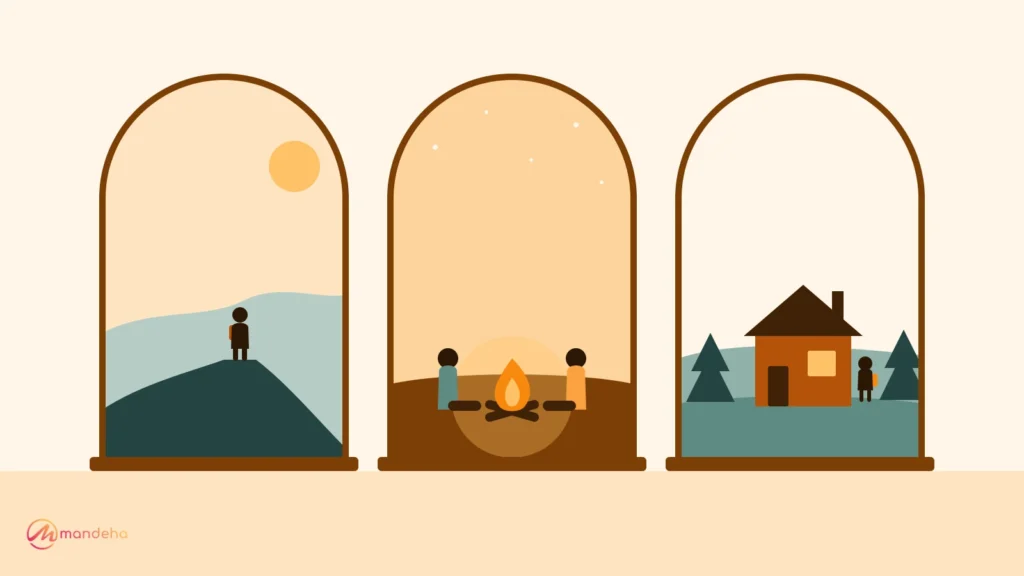
The benefits of travel psychology aren’t one-size-fits-all. Different types of trips reach for different psychological levers:
- Solo travel works largely through identity and self-efficacy. Travelling alone removes the social scaffolding that usually organises a trip, which forces, and often rewards, a stronger sense of self-reliance.
- Group and couples’ travel lean more on connection and shared novel experience.
- Hospitality-designed stays are increasingly built around psychological outcomes on purpose, such as recovery, connection and reflection, rather than generic amenities. This is the whole premise behind the benefits of hospitality psychology.
- Tourism more broadly works through similar stress-recovery and memory mechanisms, but at a destination-design level. We cover this in benefits of tourism psychology.
Understanding travel and wellbeing psychology at this level means recognising that “just take a vacation” is incomplete advice. The design of the trip matters as much as the destination. Matching the trip type to the need is the simplest way to get more of the benefits of travel psychology from the same holiday, and it is a core idea in the psychology of travel.ake a vacation” is incomplete advice – the design of the trip matters as much as the destination.
Why Some Trips’ Benefits Fade, and How to Make Them Last

Here’s the honest part of the benefits of travel psychology: they don’t always last.
The de Bloom meta-analysis found something important. The health and wellbeing gains from a vacation fade soon after people return to work. This is sometimes called the vacation fade-out effect, and it is why so many people feel they need another holiday a month after the last one.
So how long vacation benefits last depends less on the trip itself and more on what happens around it. Making the benefits of travel psychology last is less about willpower and more about design. What extends them: pre-trip preparation, genuine psychological detachment during the journey (not checking email), and structured post-return reflection.
This is the difference between a standard vacation and intentional travel: trips designed with the fade-out effect in mind from the start. In practice, three habits help most. Set a clear intention before you leave, protect your detachment while you are away, and reflect on what changed within a few days of getting home.
The return deserves attention too. The flat, restless feeling many people have after coming home is common, and it often signals that the trip met a need ordinary life is not meeting. Paying attention to the return is part of travel and wellbeing psychology, not an afterthought. We share practical ways through it in our guide to post travel blues.
So the honest answer to “why do some vacations make you calmer than others” isn’t the destination. It’s whether the trip was designed to make the benefits of travel psychology stick.
Who Benefits Most from Travel Psychology
The benefits of travel psychology are not limited to one kind of traveller. In my work, five groups tend to gain the most:
• Individual travellers who want a trip to change how they feel, not just where they have been.
• People recovering from stress or burnout, who need rest that actually restores, alongside any professional support they already have.
• Couples and groups, who can use shared travel to build trust and connection rather than test it.
• Psychologists and therapists, who increasingly use travel as one part of a client’s wider plan. Our travel psychologist page explains how Mandeha works with practitioners.
• Hospitality and travel brands, who can design stays and destinations around psychological outcomes. This is the focus of tourism psychology and hospitality psychology. It also raises a fair question: does tourism care about mental health, or is that burden still entirely on the traveller?
Each group draws on travel’s psychological benefits in a different way, so a good plan starts from who you are and what you need.
If you see yourself in any of these groups, Mandeha’s travel psychology services are built to help you plan for the benefits of travel psychology you need most.
How Mandeha Applies Travel Psychology
At Mandeha, we use our LEGIT Travel Psychology framework to turn these benefits into a plan. The science of travel psychology tells us what works, and LEGIT is how we put it into practice. It has five steps, always in this order:
- Intentions: we start by clarifying what you need from the trip, such as rest, perspective, connection or courage.
- Experience: we shape the trip around those intentions, from pace and place to daily activities.
- Learning: we help you notice what the trip is teaching you while it is happening.
- Growth: we turn those lessons into small changes you can carry home.
- Transformation: over time, those changes add up to a lasting shift in how you live and travel.
The aim is simple: to make the benefits of travel psychology hold long after you have unpacked.
Conclusion: Making the Benefits of Travel Psychology Last
The benefits of travel psychology are real, but they are not automatic. Travel can ease stress, lift mood, open your thinking, strengthen your sense of self and bring people closer. Whether those changes fade in a week or stay with you depends on intention, detachment and reflection. That is the real promise of the benefits of travel psychology: not a better holiday, but a better return.
Ready to build these benefits into your next trip, or your brand’s guest experience? Book a consultation with Mandeha and we will help you plan a journey that keeps working long after you return.
Frequently Asked Questions
What are the benefits of travel psychology?
The core benefits of travel psychology include faster stress recovery, better mood, restored attention, more open thinking, stronger identity and confidence, closer relationships and greater resilience. They are strongest when a trip is designed with clear intentions, genuine detachment from work and reflection afterwards.
How does travel change your brain?
Travel changes your brain mainly by changing what it pays attention to. New places interrupt routine thinking, give tired focus a chance to recover and, over time, reshape memory and meaning. Lower stress hormones during a good break support these psychological shifts.
Why do the benefits of a holiday fade so quickly?
They fade because most people return straight into the routines and pressures they left behind. A meta-analysis by de Bloom and colleagues (2009) found holiday gains fade soon after work resumes. Pre-trip planning, real detachment and post-trip reflection help them last longer.
Can travel make you more creative?
Yes, travel can support creativity, but mainly when it involves real engagement with another culture. Maddux and Galinsky (2009) linked creativity to living abroad and adapting to a new culture, not to tourist travel alone. Depth of engagement matters more than distance.
Who should work with a travel psychologist?
Anyone who wants a trip to change how they feel can benefit, especially people recovering from stress, couples, groups and solo travellers. Psychologists, therapists, and hospitality and travel brands also work with travel psychologists to design trips around psychological outcomes.
How does Mandeha apply travel psychology to trips?
Mandeha uses its LEGIT Travel Psychology framework: Intentions, Experience, Learning, Growth and Transformation. We clarify what you need, design the trip around it, help you notice what it teaches you, and turn those lessons into changes that last after you return.
