

- Why Most Corporate Retreat Planning Fails to Change Anything
- The Psychology Behind Effective Corporate Retreat Planning
- Corporate Retreat Ideas That Actually Work
- How to Plan a Corporate Retreat: A Step-by-Step Framework
- Employee Wellness Retreat: Where Wellbeing and Performance Overlap
- Corporate Retreat ROI: What to Actually Measure
- Corporate Retreat for Small Teams vs. Large Organisations
- Corporate Retreat Planning: Three Takeaways
- Frequently Asked Questions
Quick Answer: Effective corporate retreat planning starts with one clear goal, a small number of well-designed moments, and a measurement plan set before the event. As a travel psychologist, I find retreats work when they build trust and shared experience, not when they pack every hour with sessions. Measure results over the following quarter.
Most corporate training fade within weeks. People leave a hotel conference room with a folder of notes, return to the same inbox, and the new habits never arrive. A retreat can break that pattern, but only if it is designed rather than assembled from a venue, a speaker and a dinner.
Corporate retreat planning is the work of deciding what should change in a team, then shaping a few days around that change. As a travel psychologist at Mandeha, I use travel psychology to study how place, novelty, shared experience and endings affect what people remember and do afterwards. This guide explains how to plan a corporate retreat, from the psychology and formats to a planning framework and a realistic way to measure results.
Why Most Corporate Retreat Planning Fails to Change Anything
A retreat fails when it is treated as a reward or an event instead of a deliberate intervention. A generic seminar tells people what to do but gives them little reason to do it differently on Monday.
Three patterns appear again and again when corporate retreat planning goes wrong. The agenda is packed, so no single moment stands out. The goal is vague, such as “team bonding”, so nobody can tell afterwards whether it worked. And there is no follow-up, so the energy of the last evening never connects to daily work.
A designed experience works differently. It begins with a specific outcome, such as rebuilding trust after a restructure or helping a hybrid team handle disagreement. Every session, meal and free hour is then chosen to serve that outcome. The difference is not budget. It is intent.
Leaders also tend to confuse enjoyment with impact. A scenic location and a good dinner lift mood, which matters, but mood alone does not change how a team communicates. Employee engagement tends to improve when people see the retreat as relevant to their real work and carry its ideas home.
Copying corporate retreat ideas from another company, without asking what problem they solved there, is a common mistake.
The Psychology Behind Effective Corporate Retreat Planning
Effective retreats rely on a few well-designed moments rather than a full schedule, because people judge an experience mainly by its most intense point and its ending. This is the peak-end rule, set out by Daniel Kahneman and Barbara Fredrickson in their 1993 paper in the Journal of Personality and Social Psychology.
In plain terms, the average of every hour matters less than the high point and the last impression. For retreat design, that means one well-built peak, such as a shared challenge or an honest group conversation, and a carefully planned closing session can matter more than adding extra workshops. I explore the same mechanism in the peak-end rule in guest experience.
Planning a corporate retreat around this idea changes how you spend time. Protect one peak moment each day. Design the final hour with care, because people carry it home. Leave unstructured time, because useful conversations often happen in the gaps.
Travel psychology adds a second idea. Being away from the usual setting loosens habitual roles, so colleagues who meet only through a calendar often see each other differently on a walk or during a shared task. Good corporate retreat planning uses that shift on purpose, because it supports team cohesion only when activities give people something real to do together.
Corporate Retreat Ideas That Actually Work
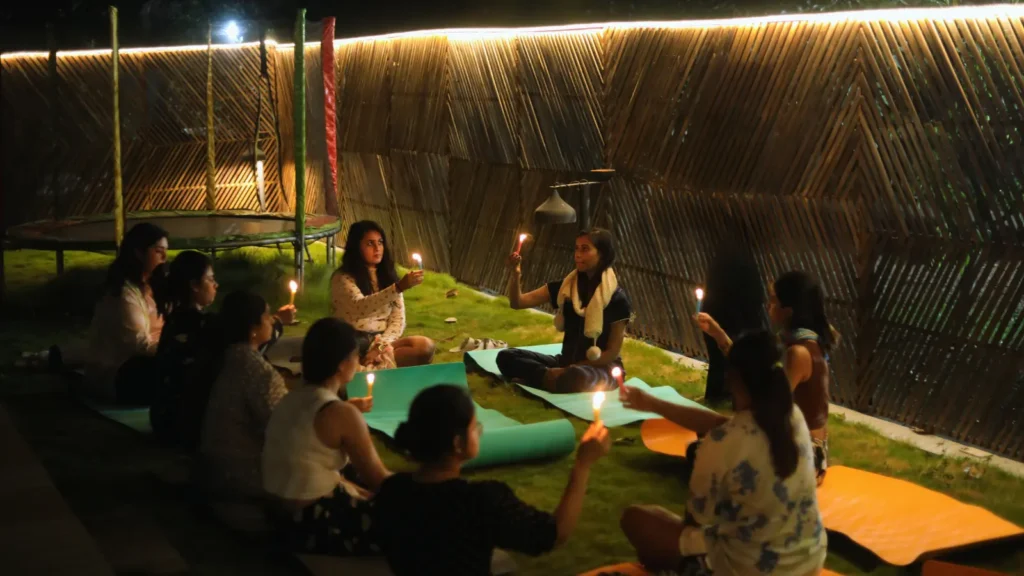
In corporate retreat planning, the best corporate retreat ideas match a format to a goal, not to what is fashionable. Three formats fit the psychology above.
Mindfulness and movement. Morning walks, gentle stretching or breathing practice slow the pace and help people arrive mentally. Keep it optional and secular, and do not present it as treatment. It works best as a start-of-day ritual rather than a main event.
Skills-based challenges. Mixed groups solve a practical problem together, such as a cooking task, a navigation exercise or a build. These create the shared peak moment and show how people really collaborate under mild pressure. Debrief afterwards by linking what happened to real work.
Structured reflection time. Guided journaling, paired conversations and a closing circle give people space to name what they will change. This is the most underused of the corporate retreat ideas, and often the one that makes the others stick.
Match the format to the goal:
| Retreat goal | Recommended format | What to look for afterwards |
| Rebuild trust | Skills-based challenge plus a closing circle | More open disagreement in meetings |
| Reduce stress and fatigue | Mindfulness and movement, with free time | Better pacing; lower reported strain |
| Align on direction | Structured reflection and paired conversations | Shared language about priorities |
| Integrate a new team | Mixed-group challenge, then a debrief | Wider collaboration across functions |
Whichever you choose, include one session where the team discusses how it actually works together. For a worked example of how a retreat can be structured and reviewed, see a retreat case study from Mandeha. These corporate retreat ideas can be combined, but resist doing all three every day.
A practical test for any of the corporate retreat ideas above: if you removed the activity, would the goal still be served? If yes, replace it.
How to Plan a Corporate Retreat: A Step-by-Step Framework
Knowing how to plan a corporate retreat comes down to five decisions: one outcome, the group size, the budget, the timeline and the follow-up. Each narrows the choice that follows.
- Set one goal. Write a single sentence: after this retreat, the team will be able to… If you cannot finish that sentence, you are not ready to book a venue.
- Decide group size and format. Group size shapes the design. A group of about 15 or fewer can hold one conversation together, while larger groups need breakout teams and more facilitators. Pick corporate retreat ideas only after the goal and group size are fixed.
- Set the budget. Fund design and facilitation first, then the venue, then extras. A modest venue with a strong design usually serves the goal better than a luxury venue with a loose agenda.
- Build the timeline. For a multi-day event, start two to three months ahead. Send a baseline survey before the retreat, since corporate retreat ROI cannot be judged without one, and book the follow-up check-ins before anyone leaves.
- Plan the follow-up. Agree what happens in the first month: who owns each commitment, and when the team will review progress.
Teams planning a corporate retreat for the first time often skip step 5.
A structured planning tool can help turn the goal into sessions. Mandeha’s Tangible Travel Tool is one option; its page explains what it covers. Corporate retreat planning is easier when every choice traces back to the goal.
Employee Wellness Retreat: Where Wellbeing and Performance Overlap

An employee wellness retreat works when it helps people feel safe enough to speak honestly, which is where wellbeing and performance meet. Amy Edmondson’s 1999 study in Administrative Science Quarterly examined team psychological safety, meaning a shared belief that the team is safe for interpersonal risk-taking, such as admitting a mistake or raising a concern.
Wellbeing is not a perk layered on top of performance. A team that can admit errors early catches problems earlier, and a retreat can model that habit by letting leaders go first: naming a mistake, asking for feedback and responding calmly.
An employee wellness retreat should also respect limits. It is not therapy, and it should not push people to disclose personal details. Offer choice in every activity and keep participation voluntary.
If wellbeing is the goal, measure it modestly in your corporate retreat planning: ask whether people feel able to speak up, not whether they are happy. An employee wellness retreat that improves candour is doing real work. Some corporate retreat ideas, such as unstructured hikes, serve wellbeing well but need a clear debrief to link back to work.
Teams under sustained pressure may need a different emphasis. Burnout prevention belongs in the schedule through realistic pacing and real rest, while burnout recovery for individuals who are already depleted is a longer process that a retreat alone cannot complete. Team cohesion grows when people feel supported rather than assessed.
A well-run employee wellness retreat leaves people with agreements, not just good memories.
Corporate Retreat ROI: What to Actually Measure
Corporate retreat ROI is best judged by comparing a baseline taken before the event with changes in sentiment, engagement and retention over the following quarter. No single number captures it, and honest reporting says so. Measurement belongs in corporate retreat planning from the first meeting, not after the event.
How to Measure Corporate Retreat ROI in Three Steps
Pre and post sentiment surveys. Ask the same short questions two weeks before, one week after and again at about three months. Focus on trust, clarity of goals and willingness to raise concerns.
Retention and engagement metrics. Track what you already collect, such as voluntary turnover and engagement scores, for the quarter after the retreat against the quarter before. Be cautious about crediting the retreat alone, because many factors move these numbers.
Qualitative feedback. Short interviews or open comments show what changed in behaviour. Are meetings more open? Are disagreements resolved faster?
For a cost view, compare what the retreat cost with the value of the outcomes you can reasonably link to it, such as lower turnover, and report the result as a range with your assumptions stated. This is how to measure corporate retreat ROI without overclaiming. Corporate retreat ROI is an estimate, not an invoice.
Corporate Retreat for Small Teams vs. Large Organisations
A corporate retreat for small teams can be simpler, cheaper and more personal, while large organisations need extra structure to stop the event turning into a conference.
Small teams (about 8 to 15 people). Keep to one location and one shared conversation, and let the whole group be the peak moment. A corporate retreat for small teams also benefits from a longer reflection block, because everyone can be heard. Good corporate retreat ideas for small teams include a shared meal prepared together and a long walk with paired conversations.
Large organisations (30 or more). Split into mixed-function groups of six to eight, brief trained facilitators and keep plenary sessions short. Corporate retreat planning at this scale also needs a communication plan, so colleagues who did not attend hear what changed. At scale, corporate retreat ROI depends on comparing groups, since averages can hide the teams that changed most.
Teams between those sizes can run a shared opening and closing, with smaller groups in between. Whatever the size, corporate retreat planning should start from the goal, not the headcount.
Corporate Retreat Planning: Three Takeaways
Corporate retreat planning succeeds when it is built around one goal, a few strong moments and a plan to measure the result.
- Design for the peak and the end. Whichever corporate retreat ideas you pick, a few well-built moments and a careful close beat a full schedule.
- Build psychological safety first. Honest conversation is what turns a pleasant retreat into lasting change.
- Measure before and after. Report corporate retreat ROI as an honest range, using surveys, retention and engagement data, and qualitative feedback.
If you are working out how to plan a corporate retreat for your team, Mandeha’s travel psychology consultants for hospitality and corporate teams can talk through your goals and options.
Frequently Asked Questions
What is corporate retreat planning?
Corporate retreat planning is the process of setting a goal for a team event, then designing the format, budget, timeline and follow-up to achieve it. It treats the retreat as a deliberate intervention rather than a social occasion.
How to plan a corporate retreat when the budget is tight?
Spend on design and facilitation first, and choose a simple, nearby venue. One strong shared experience and a good closing session matter more than luxury.
How to measure corporate retreat ROI?
Compare survey results from before the retreat with results one week and three months after, and track retention and engagement over the next quarter. Add qualitative feedback, and report the outcome as a range, since other factors also affect these numbers.
What are good corporate retreat ideas for a remote or hybrid team?
Pair a skills-based challenge with a structured reflection session and a clear closing ritual. Shared tasks in person help remote colleagues see how each other works, which a video call rarely shows.
Is a corporate retreat for small teams worth it?
Yes, when it has a clear goal and a plan to follow up. Small groups let everyone speak, which supports trust and team cohesion, and the cost is often lower than a large event.
What makes an employee wellness retreat effective?
It builds psychological safety, offers choice in every activity and connects the experience back to daily work. It should never be presented as treatment.