

You come home from a trip with photos, a few gifts and one quiet question. The place gave you so much. What did you give it?
Most of us were taught to travel lightly and take only memories. That is a good start. A regenerative travel mindset asks for one more step: to leave something good behind.
This is not about grand gestures. It is a way of thinking that shapes small choices before, during and after a trip.
This guide looks at the psychology of regenerative travel from the traveller’s side: what the mindset is, why some travellers give back, and how to build it through simple habits, in India and beyond.
What is a regenerative travel mindset?
A regenerative travel mindset is the belief that your trip should leave a place better, not just unharmed. It rests on three parts: an intention to create positive impact, fair give and take with local communities, and care for the place long after you return home.
What Is a Regenerative Travel Mindset?
A regenerative travel mindset is a steady way of thinking in which you see each trip as a chance to improve a place, not only to enjoy it. It combines three beliefs: travel should do some good, hosts deserve fairness, and your responsibility continues after the journey ends.
People often ask, what is a regenerative mindset in travel, and how does it differ from simply being careful? From a travel psychology view, the short answer is direction.
Being careful looks at the damage you avoid. A regenerative traveller also looks at the good that can be added.
Regenerative tourism is what destinations, hosts and operators build. A regenerative travel mindset is what you bring with you.
Beyond Doing Less Harm
For years, the main message to travellers was to reduce harm. Carry your own bottle. Refuse plastic. Stay on the trail.
These habits still matter, and a sustainable travel mindset remains the foundation. Regenerative tourism builds on it.
A paper in the Journal of Tourism Futures describes regenerative tourism as aiming for a net positive benefit to people, places and nature. It also examines the mindset shift, systems change and boundary-spanning practices that a regenerative approach needs.
Harm-reduction mindset vs regenerative mindset
| Area | Harm-reduction mindset | Regenerative mindset |
| Core question | How do I do less damage? | How do I leave this place better? |
| View of the place | A destination to protect | A living community to support |
| Role of the traveller | Careful visitor | Active contributor |
| Money | Spend responsibly | Spend so that value stays local |
| Time frame | Ends when the trip ends | Continues after you return home |
Neither column is wrong. The second simply aims to leave a place better than you found it.
The Three Parts of the Mindset
The clearest description in the psychology of regenerative travel comes from recent research. A study by Shamim and Sreejesh introduces the Regenerative Travel Mindset as a trait-like belief system with three dimensions:
- Positive impact intentionality: meaning to do some good, not only to avoid harm
- Community reciprocity: fair give and take with the people who host you
- Long-term stewardship: care for a place that lasts beyond the trip
The authors report a reliable, validated scale for measuring it. So a regenerative travel mindset is more than a slogan.
The Psychology of Regenerative Travel
The psychology of regenerative travel explains why some people feel responsible for the places they visit. It points to three inner drivers: an intention to do good, a sense of fairness towards hosts, and a feeling of care that outlasts the trip.
In travel psychology, we study what happens in the mind before, during and after a journey. The psychology of regenerative travel sits naturally inside that picture.
The study by Shamim and Sreejesh also links the regenerative travel mindset to higher-impact regenerative behaviours, such as choosing surplus-positive packages or supporting community-led conservation projects.
Regenerative tourism needs good systems. It also needs travellers who arrive ready to take part.
Positive Impact Intention
This is the starting belief: my trip can do some good. In the psychology of regenerative travel, intention comes first because it directs attention.
You begin to carry new questions with you:
- Who benefits from this booking?
- What does this place need more of?
- What can I offer that is actually useful?
Community Reciprocity
Community reciprocity means fair give and take. You receive welcome, food, stories and space. In return, you offer respect, fair payment and real attention.
Travel that gives back begins with seeing hosts as partners, not as a backdrop for photographs. Pay a fair price, and listen more than you speak.
Long-Term Stewardship
Stewardship is care that lasts. A steward does not own a place, yet feels responsible for it.
This is the part of a regenerative travel mindset that continues at home. You keep in touch, recommend honest local businesses, and return or support the place from afar.
Regenerative tourism depends on this long view. In the psychology of regenerative travel, it separates one kind moment from a lasting habit.
Why Giving Back While Traveling Can Feel Meaningful
Giving back while traveling can feel meaningful because it connects your trip to something larger than your own enjoyment. When your choices help a host family, a guide or a landscape, travel that gives back may feel more purposeful. This differs from person to person and is never guaranteed.
Why do some travellers give back to destinations while others pass through without a second thought? Part of the answer lies in what each person believes travel is for.
This is where the psychology of regenerative travel becomes personal.
Sense of Meaning and Purpose
Many people travel for rest and fun, and that is perfectly fine. Others also look for a sense of meaning.
Travel that gives back can offer this. Helping a place you have enjoyed may leave you with a quiet sense of purpose, and with memories that hold people as well as views.
This is not a promise. A regenerative travel mindset simply opens a possibility worth noticing in yourself.
Guilt vs Purpose
Some travellers give back out of guilt about flights, crowds or privilege. Guilt can push people to act, but it is a heavy fuel that may fade quickly.
In the psychology of regenerative travel, purpose works differently:
- Guilt asks, what have I done wrong?
- Purpose asks, what good can I do here?
A regenerative travel mindset grows better from purpose. You do not need to feel bad to do good.
How to Build a Regenerative Travel Mindset: 7 Thoughtful Habits
You build a regenerative travel mindset through small, repeated habits, not one big act. Plan with intention before you go, make fair and curious choices while you are there, and stay connected after you return. If you are wondering how to become a regenerative traveller, these seven habits are a practical place to begin.
Habits are where the psychology of regenerative travel turns into practice.
Before the Trip
- Set one giving intention. Decide one way this trip will benefit the place, and write it down. This small step is the heart of intentional travel.
- Research who benefits. Look for stays, guides and tours owned by local people. In regenerative tourism, where your money lands matters as much as how much you spend.
During the Trip
- Spend where value stays local. Eat at family kitchens, buy from the maker and hire local guides. Travel that gives back is often ordinary spending pointed in a better direction.
- Give attention, not only money. Ask questions, learn names and slow down. Many mindful travel tips apply here, because small everyday choices add up.
- Join one hands-on effort, if invited. A beach clean-up or village project can be worthwhile when local people lead it.
After the Trip
- Share honestly. Review and recommend the local businesses that cared for the place.
- Stay connected. Keep in touch with a host, support a local project or plan a return visit. Stewardship begins when the holiday ends.
Regenerative travel for beginners does not require all seven at once. Choose two for your next trip and add more with time. A regenerative travel mindset grows through practice, not pressure.
Regenerative Travel in India
Regenerative travel in India means choosing trips where local communities lead and benefit. Villages, hill towns, forests and coasts offer many chances to stay with families, learn from local guides and support traditional crafts. Travel that gives back is easy to begin here when you carry respect and curiosity with you.
If you already enjoy India cultural tourism, you have a natural entry point.
Regenerative tourism in India puts community at the centre. A regenerative travel mindset helps you find it.
Respecting Local Culture
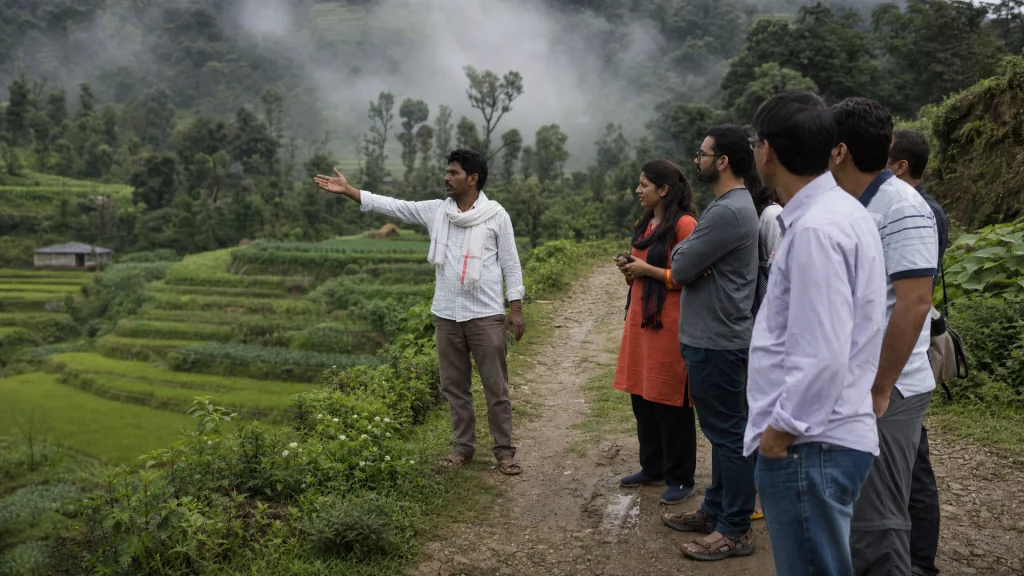
India changes every few hundred kilometres. Respect begins with noticing that.
- Dress to suit the place, especially at temples, mosques, gurdwaras and villages
- Ask before you photograph people, rituals or homes
- Learn a greeting in the local language
This is also where authentic travel and regeneration meet. You honour a culture best by meeting it as it is, not as a show staged for visitors.
Choosing Community-Led Experiences

Look for experiences that local people own, run and shape:
- Homestays run by families instead of outside operators
- Village walks led by residents
- Craft workshops where artisans are paid directly
Before you book, ask who owns it, who is employed and what stays in the village. Clear answers suggest that the regenerative tourism on offer is real, not just a label.
This is travel that gives back in its simplest form: your visit becomes fair income for a neighbour.
Common Barriers and How to Handle Them
The most common barriers are cost, convenience, doubt about greenwashing and the feeling that one person cannot make a difference. Each is real, and none needs to stop you. A regenerative travel mindset works at any budget and any scale, because it begins with intention and grows through small, steady choices.
Cost and Convenience
The World Economic Forum argues that travellers themselves need a mindset shift, and notes that cost-of-living pressure makes this hard.
Travel that gives back does not have to cost more:
- A family homestay can cost less than a hotel
- Local food is often cheaper than imported menus
- Time, attention and a kind review are free
When the better choice is less convenient, try it once per trip instead of every time.
Doubt About Greenwashing
Regenerative tourism is an appealing label, and appealing labels can be misused. Look for specifics instead of slogans:
- Named local partners
- Clear details on where your money goes
- Local ownership, or local staff in senior roles
If an operator cannot answer basic questions, keep looking. A regenerative travel mindset includes healthy doubt.
Feeling Overwhelmed
You cannot repair a destination in a week, and nobody expects you to. The psychology of regenerative travel is about direction, not perfection.
No regenerative traveller gets everything right. Travel that gives back is built from small acts. Choose one that fits your trip, do it well, and let that be enough for now.
Final Thoughts: Travel That Gives Back
A regenerative travel mindset is not a rulebook. It is a gentle shift in how you see your place in someone else’s home. Start with one intention, one fair choice and one lasting connection.
In time, the wish to leave a place better than you found it may become part of how you travel. Travel that gives back starts small. For guided support, explore a travel psychology journey with Mandeha.
This article is for informational purposes only and is not a substitute for professional mental health advice.
What is a regenerative travel mindset?
A regenerative travel mindset is the belief that travel should leave a place better. It combines positive impact intention, community reciprocity and long-term stewardship, and guides small choices throughout a trip.
How is regenerative travel different from sustainable travel?
Sustainable travel focuses on reducing harm and keeping a place as it is. Regenerative tourism goes a step further and aims to leave people, places and nature better off.
How can beginners start with regenerative travel?
Regenerative travel for beginners starts with one intention per trip. Choose a locally owned stay, hire a local guide, spend where value stays local, and share an honest review.
Does giving back while traveling make you happier?
It may. Research suggests a regenerative travel mindset is linked to more regenerative behaviours, but it does not prove you will feel happier. Treat a sense of meaning as a possibility, not a promise.
Is regenerative travel possible on a budget?
Yes. Travel that gives back depends more on where you spend than how much. Homestays, local food, respectful behaviour and honest reviews all support a place without raising your costs.
How do I avoid greenwashing when choosing regenerative trips?
Ask who owns the business, who is employed and where your money goes. Look for named local partners. Vague regenerative tourism claims with no evidence are a reason to keep searching.